

We Can't Handle The Truth
A reminder for why reading fiction is a good thing...

The Atlantic article I wrote about in last Thursday’s post is getting a lot of attention.
One of my favorite writers on writing, Ann Handley, also addressed the apocalyptic tone of a post-literate reading society the article claims we are doomed to continue.
Ann, too, thought the tone was a bit much. Ann took a more positive spin in response, as I did:
“But what drives me bananas about articles like The Atlantic‘s is that they predict a future they insist is so inevitable.
It’s not. The future never is.
When everything else gets faster and cheaper, the stuff that requires real-time and attention becomes more important, more valuable. It becomes a choice—that (the data shows) many of us are already making.
Reading is not dead. Not dying. But we do have to consciously build the habit.
Once you get into the routine of it, your muscles feel so good.”
Ann also uses the gym/reading analogy in her newsletter. I was so excited that a writer I admire also wrote about The Atlantic piece that I sent Ann my post. AND SHE RESPONDED! She even quoted a line of mine back in her response! I was beyond excited that this happened! But back to the good stuff…
The part of the quote above I agree with most is that reading is a choice. It has to become a choice in our lives, and I think, and it seems like Ann agrees, that we are already making it.
But let’s get deeper into the decision-making part of it all. If we are choosing reading to begin with, then why choose fiction?
GREAT QUESTION! Happy to answer or give my thoughts on the matter ;)
Let’s think about this: Why does reading great literature feel different from scrolling?
My good friends at Ageless Literature describe it this way,
“Your brain must build the world. Every scene, every image, every emotion is constructed internally. You become both the reader and the creator, running a private simulation with astonishing fidelity.”
This is why I have a hard time reading a book if I've seen the movie adaptation before I stumble upon it. A movie does the fun imagination work for me. I don’t want to read the book if I can’t imagine how the story unfolds on my own. I want to co-create the story in my head with the story on the page.
The simulation we create along with the book has a purpose. Ageless Literature brilliantly states that by reading great fiction,
“You could witness betrayal without being betrayed. You could feel the cost of pride without ruining your life. You could explore love, war, ambition, jealousy, tragedy - all through someone (a fictional character’s) mistakes.
Books become a rehearsal for reality.”
But more than that…
“Great literature forces you to understand other minds. Researchers call this “Theory of Mind”: the ability to infer what others are thinking and feeling. You get better at reading people because you practice reading characters.”
You don’t get that from social media.
“Platforms reward snap judgment. Novels reward patience and inference. One trains outrage. The other trains empathy and nuance.”
The books we read become a part of us.
“fMRI studies show lingering activation in neural networks for days afterward, a kind of cognitive afterglow.”
Many years ago, when I was an intern, I was commuting home after a long day at the office. We were packed into the metro car like sardines. It’s a weird form of intimacy among strangers who will never see each other again.
As we rocked along, I noticed an older man sitting in one of the coveted seats, reading a book. The expression on his face was captivating. He was clearly being transformed by what he was reading. The man finished the book. Closed it and put his hand gently on the back cover. The way a person puts their hand over their heart when they are experiencing something touching. He looked up, and we briefly made eye contact.
This very professional, buttoned-up Washington, D.C. man was crying.
Over a book.
Feeling like we both had been caught, we both looked away at the same time.
But I thought to myself, “I feel you, sir. I get it.” I wasn’t staring at him to shame him. I wanted to telepathically tell him it’s okay to feel something so deeply about a piece of literature that it moved him to tears.
That man was transformed by that book. And I’m willing to bet he wasn’t the same after finishing. He probably still thinks about that book. Just like I still think about him.
I don’t know about all of you, but I’ve never cried over a social media post. I’ve never felt transformed by a tweet. But a great book? There are so many books I’ve read that have wrinkled pages from the tears I’ve shed over characters, stories and endings.
“Reading builds you in ways you cannot feel in the moment. Over a lifetime, these traces accumulate. Scenes become reference points. Characters become internal voices. Lines of prose become tools for making sense of your own life.”
Many books ago, I read a story about a character who collected kintsugi pottery. I had never heard of kintsugi pottery before. And what I discovered changed my worldview.
If you aren’t familiar, kintsugi is the Japanese traditional art of repairing broken pottery with gold lacquer. A piece of pottery that, when its broken pieces are put back together, is more beautiful than it was before. The broken seams aren’t hidden; they are celebrated with the gold. The “scars” tell the beautiful history of the piece. That is the heart of the philosophy behind kintsugi, which is called wabi sabi.
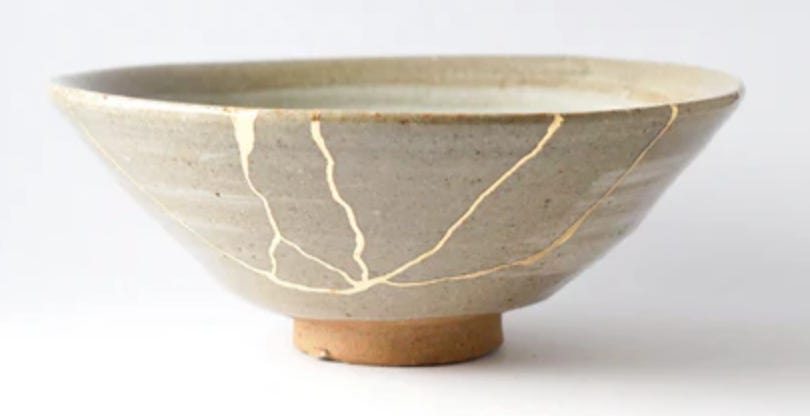
Very different from the Western tradition of shiny, new, and young. At the time I read about this character and kintsugi, I was feeling a little broken. This philosophy really healed something in me. This. Was. All. From. A. Book. :)
My point in sharing all of this is that fiction makes life more palatable because, let’s be honest, we can’t always handle the hard truths in real life in real time. And that’s okay. I think it is okay to lean on fiction a little. To hold its hand when things get hard. To process through something via story and characters in a book. Or sometimes we just want to read a story that brings us joy. Fiction contains multitudes.
So let’s make that choice together, yeah? Let’s continue rebelling and reading. Over and over again, until reading books in our world is as natural as breathing.
Who’s with me?
Preach it to the choir and beyond, Kathleen! I was born in!!
Did you order a CODE RED!!!